Buying a Tenant Time and Reading Statutes Plainly

November 9, 2025
I represented a residential tenant, a widowed parent of two school-aged children. The tenancy was not Rent Stabilized or subject to the Good Cause Eviction Law. My client needed to buy time in the premises, without breaking the bank on legal fees, so that the my client could buy a home.
In response to the service by landlord of a predicate notice to a summary holdover proceeding, I wrote a letter to landlord’s counsel. Most of the rest of this post is copied and pasted from the letter:
The Notice is defective for the following reasons.
You cannot combine an RPL § 226-c notice with an RPL § 232-a notice.
Well, to begin with, you invoked Real Property Law (“RPL”) § 232 (as opposed to 232-a) in the Notice. RPL § 232 states:
“An agreement for the occupation of real estate in the city of New York, which shall not particularly specify the duration of the occupation, shall be deemed to continue until the first day of October next after the possession commences under the agreement.”
The above-defined Lease expires on June 30, 2025. Therefore, RPL § 232 would seem inapplicable. The Notice is defective for that reason alone. Or are you telling [Tenant] that his[1] Lease ended on October 1, 2024?
Let us assume that whoever you had draft this Notice really meant to invoke RPL 232-a. Getting back to my original point, you cannot combine an RPL § 226-c notice with an RPL § 232-a notice. They are different notices, called for by different statutes, which are intended to achieve different purposes. The purpose of RPL § 226-c is to continue the terms of the tenancy, absent a notice of non-renewal served 90 or more days before the expiration of the lease. RPL 232-a, on the other hand, is a termination notice for a monthly or a month-to-month tenant. Neither RPL § 226-c nor RPL § 232-a say that the notices may be combined, nor does any case law of which I am aware. I know what you are going to say next. You are going to tell me that RPL § 232-a refers to RPL § 226-c for its time periods. Yes. But, so what? That does not mean that these different notices, pursuant to different statutes, that do different things, can be combined.
RPL § 232-a makes it so, whether tenant is a monthly tenant or a month-to-month tenant, a landlord may not initiate a holdover proceeding against either until landlord gives such tenant a termination notice. RPL § 232-a states:
“No monthly tenant, or tenant from month to month, shall hereafter be removed from any lands or buildings in the city of New York on the grounds of holding over the tenant’s term unless pursuant to the notice period required by subdivision two of section two hundred twenty-six-c of this article…the landlord or the landlord’s agent serve upon the tenant, in the same manner in which a notice of petition in summary proceedings is now allowed to be served by law, a notice in writing to the effect that the landlord elects to terminate the tenancy and that unless the tenant removes from such premises on the day designated in the notice, the landlord will commence summary proceedings under the statute to remove such tenant therefrom.”
[Emphasis supplied.]
A “monthly tenant” is a tenant “by virtue of paying the rent monthly in advance after the lease ‘expired’…and as such [is] entitled to 30 days’ notice under Section 232–a of the Real Property Law” Lewittes & Sons v. Spielmann, 190 Misc. 35 [App Term 1st Dept 1947]. A “month-to-month” tenant is defined in RPL § 232-c as follows:
“Where a tenant whose term is longer than one month holds over after the expiration of such term, such holding over shall not give to the landlord the option to hold the tenant for a new term solely by virtue of the tenant’s holding over. In the case of such a holding over by the tenant, the landlord may proceed, in any manner permitted by law, to remove the tenant, or, if the landlord shall accept rent for any period subsequent to the expiration of such term, then, unless an agreement either express or implied is made providing otherwise, the tenancy created by the acceptance of such rent shall be a tenancy from month to month commencing on the first day after the expiration of such term.”
[Emphasis supplied.]
[Tenant] is, at this point, neither a monthly tenant nor a month-to-month tenant. Thus, it is about three months premature to give him the RPL § 232-a notice.
Service of the Notice was bad.
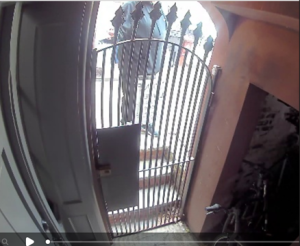
In any event, on March 31, 2025, this server (below) did not make a reasonable attempt to find a person of suitable age and discretion who lives at the Premises who was willing to accept the Notice. See Real Property Actions and Proceedings Law § 735. The doorbell is clearly visible there on the right. The server never rings it. I can email you the full video. The server walked up to the gate and shoved the paper into it. The server did not attempt to contact anyone inside the Premises and the server certainly did not stick around.
The server never made any other attempts to find anyone of suitable age and discretion. [Tenant] was home with Covid last week and his two children, their tutor, and their babysitter were at home a lot as well. We made a spreadsheet:
Just sayin…”

[END OF REPRINTED PORTION OF LETTER]
The landlord never sued my tenant-client. The tenant eventually agreed to pay some withheld rent. There were negotiations about when the tenant would leave and what the tenant would leave behind. We resolved the issues and the tenant’s vacatur was uneventful, as the tenant moved with tenant’s children to a home of their own.
By the way, do I truly believe that a landlord cannot combine an RPL § 226-c notice with an RPL § 232-a notice? Yes. I am merely following the plain language of the two statutes. I fail to see how a landlord can purport to terminate the month-to-month tenancy of a tenant whose lease has not yet expired, who has, thus, not become month-to-month. No one has yet suggested to me a satisfactory solution to that conundrum. If an appellate court eventually tells me that I am wrong, so be it.
But for now, the theory serves me and both my tenant clients and my landlord clients. Here’s the thing. I fully understand that most landlord counsel proceed by combining the RPL § 226-c notice with the RPL § 232-a notice. I assume they are doing this because they do not want to serve two successive 90-day notices. When I represent a tenant in this situation and I raise the issue, the landlord settles. I assume that no landlord wants to be the one to blow the system up for themselves and for other landlords. And when I represent a residential landlord, I do NOT combine an RPL § 226-c notice with an RPL § 232-a notice, even if it adds six months on to an eviction process. Six months is not a lot compared to the time that motion practice and appeals on this issue will eventually consume for a landlord who ultimately litigates it, so why take the chance?
In my opinion, this is one of those problems in New York City landlord-tenant law that landlords are creating for themselves. If an appellate court eventually holds that the two disparate notices cannot be simultaneously given, then hundreds of cases will be subject to dismissal and set back by months or, more likely, years.
Respectfully submitted,
[1] Some minor details changed to protect the identity of the client.